
Who’s Reviewing Your AI-generated Content Before it Publishes?
For most marketing and communications teams, the honest answer is: it depends who remembered to check. As generative AI gets embedded into everyday content production, organizations are running into a coordination problem, not just a technology problem. AI removed the scarcity around drafting, adaptation, and first-pass research. It did not remove the need for review, accuracy, rights clearance, or brand consistency.
This is where an AI content governance framework earns its place — not as a compliance afterthought, but as the operational backbone that lets a content team move fast without losing control of what goes out under the brand’s name. Below is a practical model designed to be implemented by a content or marketing operations team directly, not handed off to a separate compliance department to enforce in isolation.
Why AI Content Governance Can’t Be an Afterthought
A governance framework fails quietly when it exists on paper but isn’t enforced in practice. Teams write the policy, run a training session, and then route around the process within a quarter because it’s optional, slow, or simply forgotten under deadline pressure. By the time anyone notices, the organization has been publishing ungoverned AI content for months.
The fix isn’t more documentation. It’s building review into the actual workflow content teams already use, so governance happens by default rather than by memory.
Five Guiding Principles of AI Content Governance
Any AI content governance framework should rest on a few non-negotiable principles:
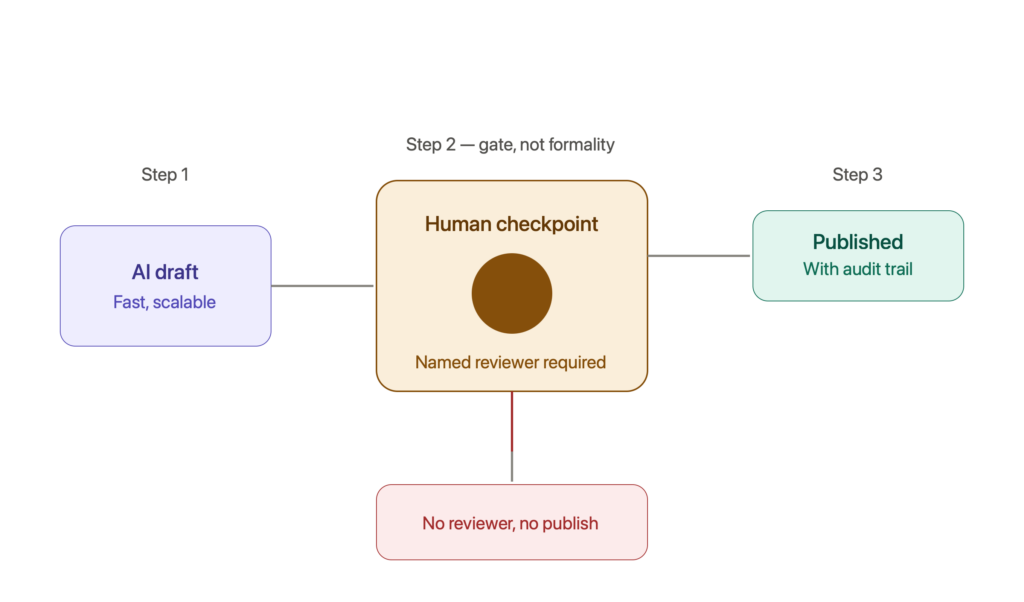
Human-in-the-loop is non-negotiable. No AI-generated or AI-assisted content publishes without a named human reviewer. This is the single rule that prevents every other failure mode on this list.
Governance lives in the workflow, not in a separate policy document. Rules get enforced at the point of publication, inside the same CMS or publishing tool the team already uses — not in a PDF nobody reopens after onboarding.
Risk scales with content type. Low-risk content, like internal drafts or social variants, should move fast. High-risk content — medical, financial, or executive-voice communications — needs layered review. Treating every piece of content with the same level of scrutiny either slows everything down or under-protects the content that actually carries risk.
Brand voice review and factual review are separate steps. Content can be accurate and still sound generic. AI defaults toward safe, familiar phrasing, so catching “technically correct but off-brand” requires a dedicated check, not a single pass that tries to do both.
Every asset has a traceable origin. What AI tool touched it, who reviewed it, and what changed at each stage should be reconstructable after the fact. This isn’t bureaucratic overhead — it’s what lets a team answer “how did this get published” when something goes wrong, and it’s increasingly expected under frameworks like the EU AI Act’s transparency and documentation requirements.
The AI Content Review Matrix
The core of any working AI content governance framework is a matrix that assigns AI’s permitted role, the required review, and the accountable owner by content type. This is the part that should be built directly into the CMS or publishing workflow — not left as guidance a busy team has to remember on its own.
| Content Type | AI Role Permitted | Required Review | Approval Owner |
|---|---|---|---|
| Social media posts | Draft + brand voice pass | Editorial review; fact-check if claims made | Content Lead |
| Blog / web articles | First draft, research synthesis | Editorial + fact-check + brand voice | Content Lead + SME |
| Customer-facing emails | Draft + personalization | Editorial + legal scan for claims/offers | Marketing Ops Lead |
| Regulated / medical / financial content | Research support only — no drafting | Full editorial + legal + compliance + SME sign-off | Compliance Officer |
| Executive / leadership communications | Drafting support only — not voice | Executive review + comms lead approval | VP Communications |
| Paid advertising copy | Draft + variant generation | Editorial + legal claims review | Marketing Lead + Legal |
The Four-Stage AI Content Review Pipeline
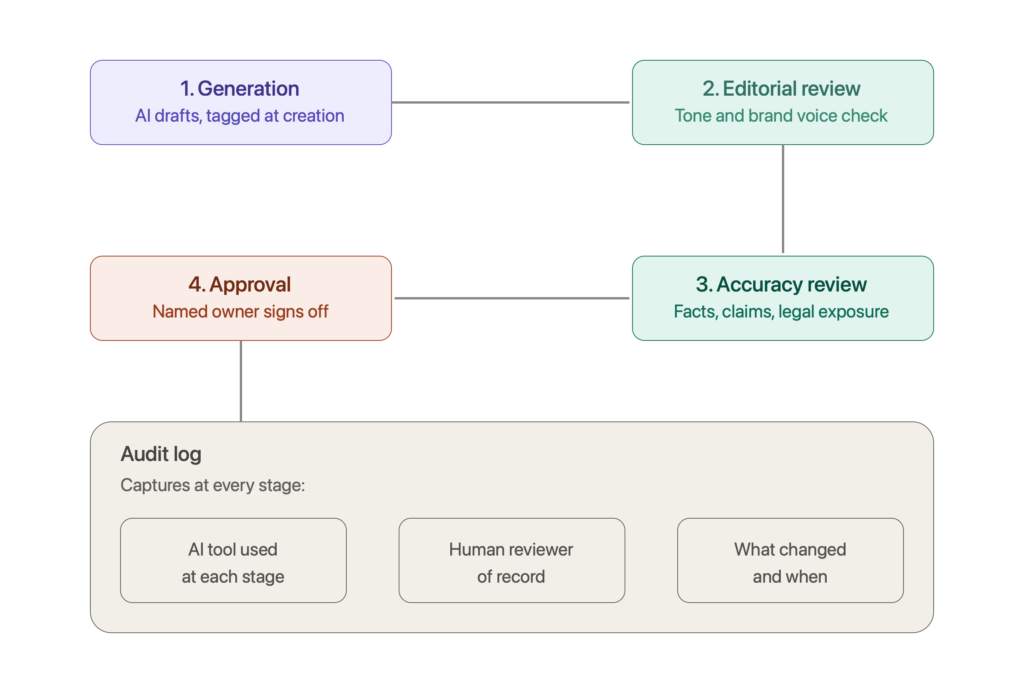
A content review matrix only works if it’s backed by a consistent pipeline every asset moves through.
1. Generation. AI tools are used for drafting, research synthesis, format adaptation, or variant generation, within the boundaries set by the content review matrix. AI-assisted drafts are tagged at creation — not as optional metadata, but as the first link in the audit trail.
2. Editorial and brand voice review. A human editor checks tone, brand voice consistency, and structural quality. This step exists specifically to catch content that’s technically fine but reads as generic.
3. Accuracy and risk review. Separate from the voice pass, a subject-matter expert — or legal/compliance for regulated content — verifies factual claims, data points, and anything that creates legal exposure. For regulated industries, this stage is mandatory regardless of content type.
4. Approval and audit log. The named approval owner signs off, and the system logs which AI tool was used, which humans reviewed it, and what changed at each stage.
Roles and Ownership in an AI Content Governance Framework
Governance fails without clear accountability. A working framework assigns:
- Content Lead — owns day-to-day editorial and brand voice review; first line of accountability for most content types.
- Subject Matter Expert (SME) — verifies factual accuracy for specialized or technical content.
- Compliance Officer / Legal — required reviewer for regulated, medical, financial, or claims-heavy content.
- VP Communications / Executive Sponsor — final approval on leadership and high-visibility external communications.
- Governance Owner — a single accountable role, typically a Director of Content Operations or equivalent, who maintains the framework itself, updates the review matrix as tools and regulations evolve, and audits whether the workflow is actually being followed rather than quietly bypassed.
Avoiding Governance Theatre
The fastest way to undermine an AI content governance framework is to build one that looks good on paper and changes nothing in practice.
Three things need to be true from day one to avoid that trap: review steps are built into the CMS or publishing tool itself, not a separate checklist; skipping a required review step blocks publication rather than just flagging it; and the audit log gets reviewed on a regular cadence, not just pulled out after something goes wrong.
Getting Started: A Realistic Rollout
Implementing this doesn’t require a six-month compliance initiative. A sprint-based rollout — piloting with one content category before expanding — keeps risk contained and lets the framework get refined against real usage instead of theory:
- Weeks 1–2: Audit current content types and existing approval processes; map each to the content review matrix.
- Weeks 3–4: Define AI usage boundaries per content type with legal and brand stakeholders.
- Weeks 5–8: Build review-stage gates into the CMS or workflow tool; pilot with one content category, such as social media.
- Weeks 9–12: Expand to all content types; train the content team on tagging, review, and escalation procedures.
- Ongoing: Review the audit log quarterly; update the matrix as AI tools, regulations, and brand needs evolve.
The Bottom Line
An AI content governance framework isn’t a final legal checkpoint bolted onto the end of the content process — it’s a creative and operational capability in its own right. The goal isn’t to slow content production down. It’s to make sure speed never outruns an organization’s ability to stand behind what it publishes.
This piece was drafted with the help of Claude (Anthropic) and edited to reflect over 20 years of hands-on experience building editorial systems, brand governance, and large-scale digital platforms.